


A Test of Strength and Weakness: The Election Through the Lens of the real Battle
The recent election in Antigua and Barbuda exposed not just party divisions, but a clear imbalance in candidate quality across several constituencies. While a handful of races carried real political weight, to include Johnson/ Bowen, Newton/Pringle, Simon/,George, Joseph/Lewis, many others were, bluntly put, non-contests.
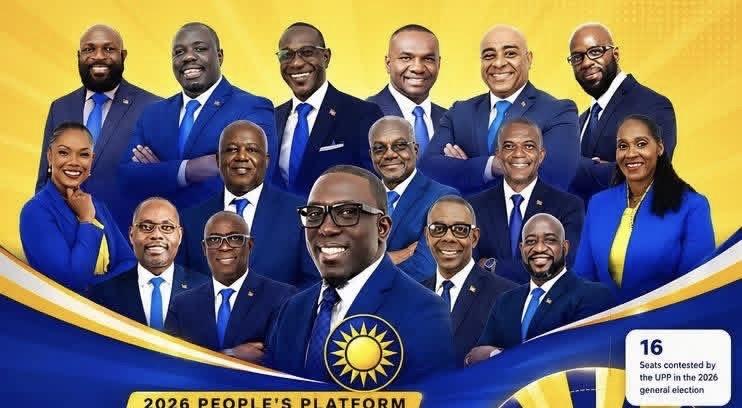
In several districts, the United Progressive Party (UPP) fielded candidates who failed to gain
traction, recognition, or credibility—outcomes that were reflected in decisive defeats.
In fact, the weakness of some opposition candidates became a talking point on the campaign trail. One Antigua and Barbuda Labour Party (ABLP) candidate, when asked about his UPP opponent, reportedly dismissed the challenge outright, saying he had “never heard of him.” While anecdotal, the remark captured a broader sentiment: in too many constituencies, the opposition simply did not present a serious electoral threat.
Against that backdrop of uneven competition, the contest involving
Anthony Smith Jr. stood out as the big battle because Smith won his seat under the UPP banner and had Switched sighting personal attacks in the upp.
Unlike the quieter races elsewhere, this constituency became a focal point of national attention and strategic maneuvering.
A major factor shaping the race was the influx of diaspora voters. A notably high number returned to participate, many perceived to be aligned against Smith. This effectively raised the stakes, forcing him to defend a significantly larger and more energized opposition base than usual.
Leading that charge was Harold Lovell, widely seen as the UPP’s most formidable figure and, in the eyes of supporters, the “big-wig” their best hope of unseating Smith. His involvement signaled that the party was deploying its strongest political asset in a targeted effort to flip the seat, and take down Smith.
The scale of that effort was evident in campaign spending and visibility. Lovell’s operation appeared to outmatch Smith’s in sheer presence, particularly with a greater number of large billboards and broader promotional posters reach. Both campaigns were clearly well-funded,
but the opposition’s strategy leaned heavily into visibility, clearly pulling down Smith’s posters.
Yet, for all that, the result underscored a recurring lesson in Caribbean politics: campaigns are not won on optics alone. Smith demonstrated resilience rooted in constituency-level credibility. Independent voters turned out in significant numbers to support him, many citing his performance as both a parliamentarian and a minister. More tellingly, there were signs that some traditional UPP supporters broke ranks, choosing continuity in supporting Smith over party alignment.
In the end, the contrast between this high-intensity race and the lackluster contests elsewhere was striking. While the UPP concentrated its resources and political capital on trying to unseat Smith, it left other constituencies exposed with candidates who were, by most measures, outmatched from the start.
The election, therefore, tells two stories at once: one of a fierce, well-funded attempt to topple a sitting political figure—and another of an opposition that, outside of a few key battlegrounds, struggled to mount credible challenges. In that sense, Anthony Smith Jr.’s victory was not
just a personal win, but a reflection of both his political durability and the uneven state of the broader electoral field.